The Language of Anatomy
Before you can think clearly about bodies in class, you need a shared language. Today you will pick up the vocabulary every directional term assumes, the words for how joints move and the three planes your students travel through every time they step on a mat.
Three things you will know by the end:
- What anatomical position is and why it matters
- The directional pairs and movement terms yoga teachers use most
- The three planes of motion and which one most of your teaching lives in
Module 1: Anatomical Position
1 screen · the reference point for everything
"Anatomical position removes the ambiguity of directional terms."
Anatomical position is the reference posture all directional language assumes. Standing upright, arms at the sides, palms facing forward, feet roughly parallel. Every directional term (anterior, posterior, medial, lateral, superior, inferior, proximal, distal) is described as if the body is in this position, regardless of what it is actually doing.
Why palms forward? It specifies forearm rotation (supination), which fixes what "anterior" means at the forearm. Without it, the term is ambiguous.
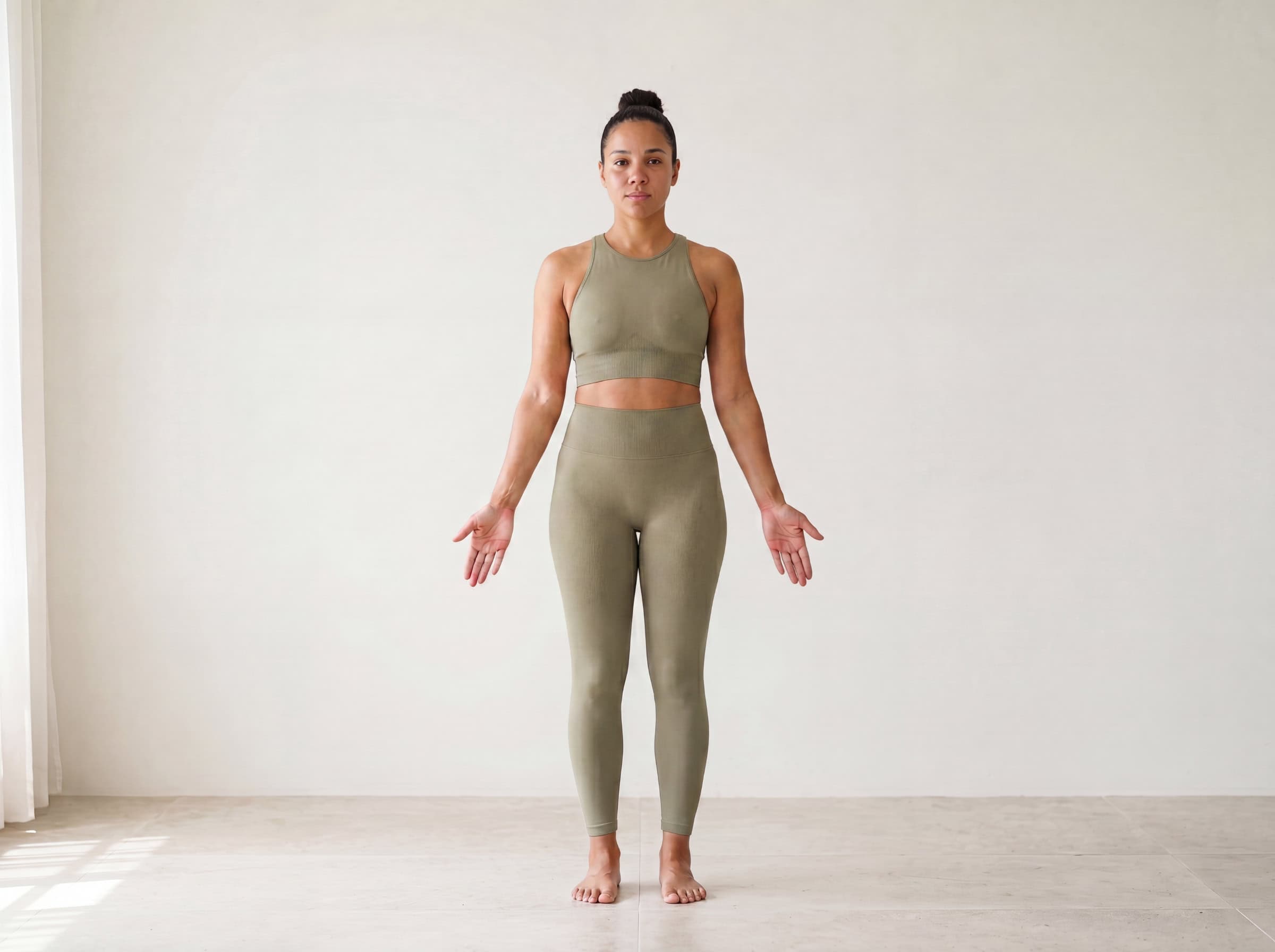
Anatomical position is essentially Tadasana (Mountain Pose) when practised with palms facing forward.
Describe anatomical position. What makes it different from simply standing upright?
Standing, palms forward, feet parallel. All directional terms assume this position. "The anterior surface of the forearm" means the palm side, because in anatomical position palms face forward.
Before you can name a direction, a movement or a location on the body precisely, you need an agreed-upon starting point. This is it. Everything else in this guide builds from here.
Module 2: Directional Pairs
Eight terms. Each one describes a direction relative to the body.
You'll cover four screens of definitions, then a short quiz. Each screen has a practice prompt to test yourself.
These are the terms physiotherapists, doctors and anatomy educators use. If a student brings you a clinic note or a medical report, these will help you better understand it. If you're ever working with a private client and their health team you'll be able to better describe what's happening in their body with a shared language.
Anterior / Posterior
Directional pair 1 of 4
Anterior — toward the front of the body.
Posterior — toward the back of the body.
Yoga asana example: In a deep hip flexion like Utthan Pristhasana (Lizard Pose), the anterior hip compresses. The posterior hip lengthens.
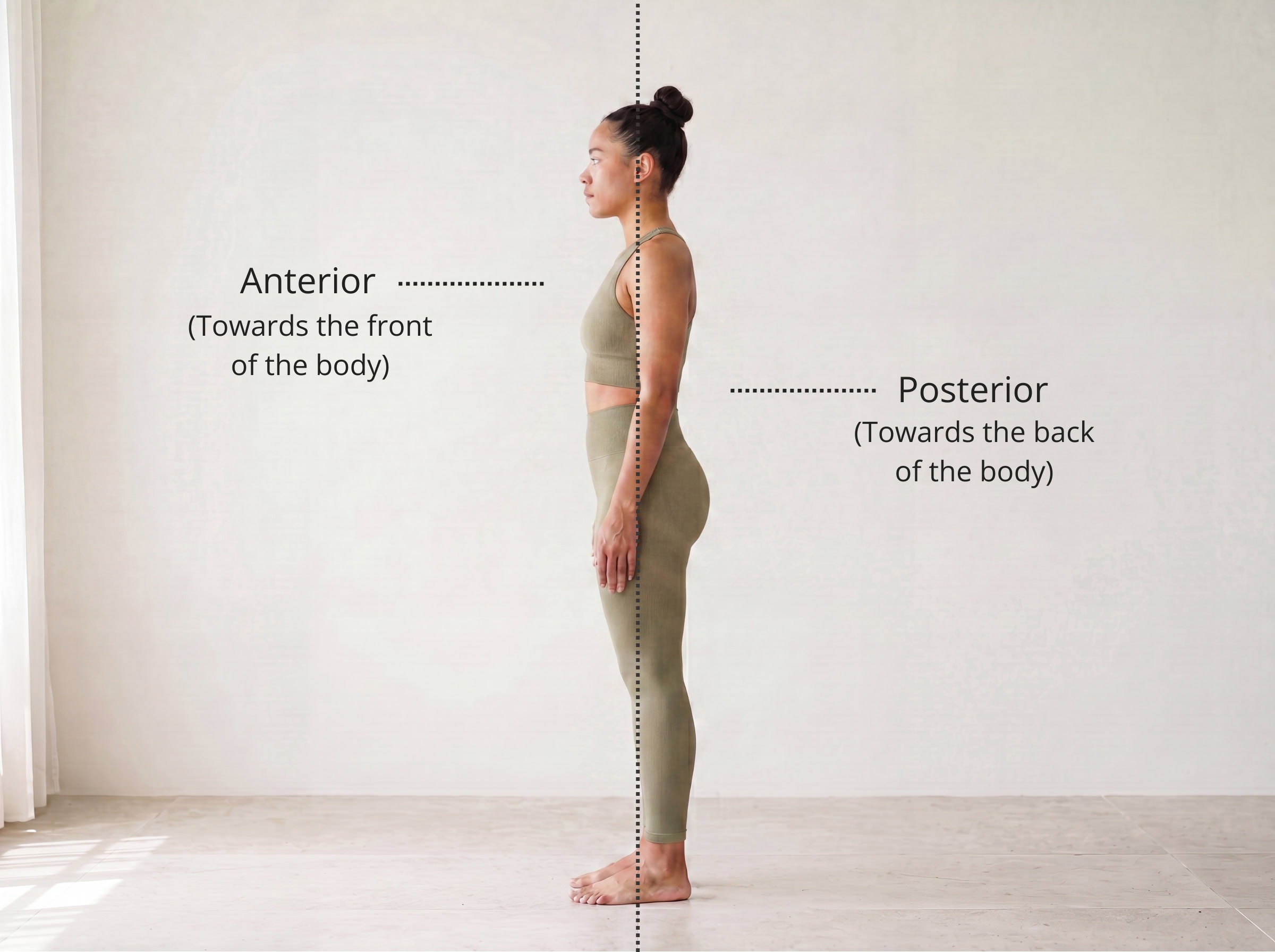
Stand in Tadasana (Mountain Pose). Place one hand on your belly (anterior) and one on your lower back (posterior). Feel both surfaces. Now move into a forward fold and notice how the anterior surface compresses while the posterior surface lengthens.
Anterior or posterior: which one means toward the front?
Anterior = front. Posterior = back.
Medial / Lateral
Directional pair 2 of 4
Medial — toward the midline of the body.
Lateral — away from the midline of the body.
Yoga asana example: The medial knee is the inner knee. "Press the outer edge of the foot down" is a lateral cue.
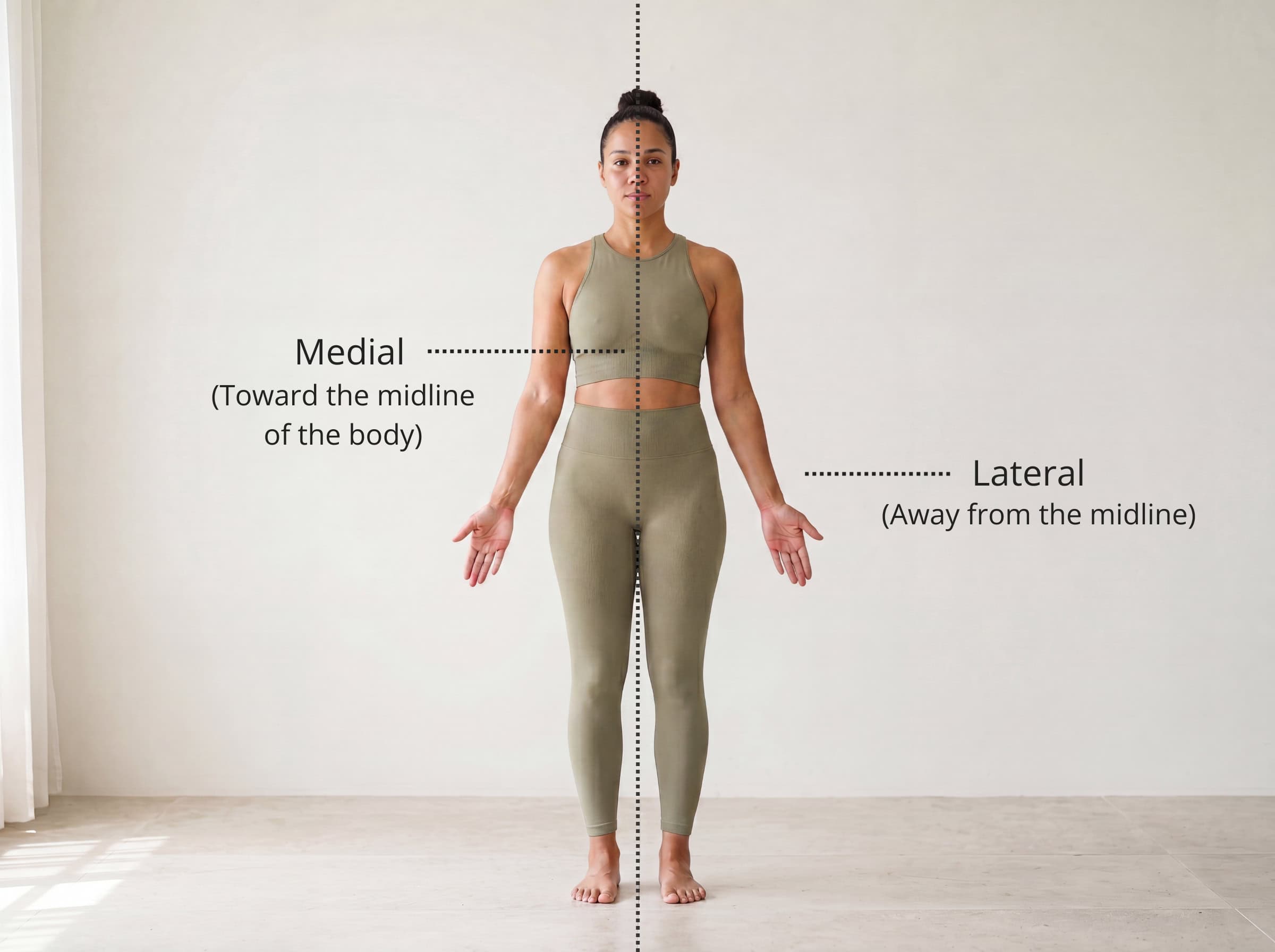
Stand in Tadasana (Mountain Pose). Draw an imaginary line down the centre of your body from head to foot. Your inner thighs are medial (close to that line). Your outer hips are lateral (far from it). Now step into Virabhadrasana II (Warrior II) and notice which part of each knee faces medially and which faces laterally.
The inner knee is the medial or lateral knee?
Medial. The medial side is always the side closest to the midline.
Superior / Inferior
Directional pair 3 of 4
Superior — toward the head.
Inferior — toward the feet.
Yoga asana example: The superior rim of the pelvis sits closest to the waist. The inferior tip of the sacrum points toward the floor in a standing asana. Inferior does not mean worse. It just means lower.
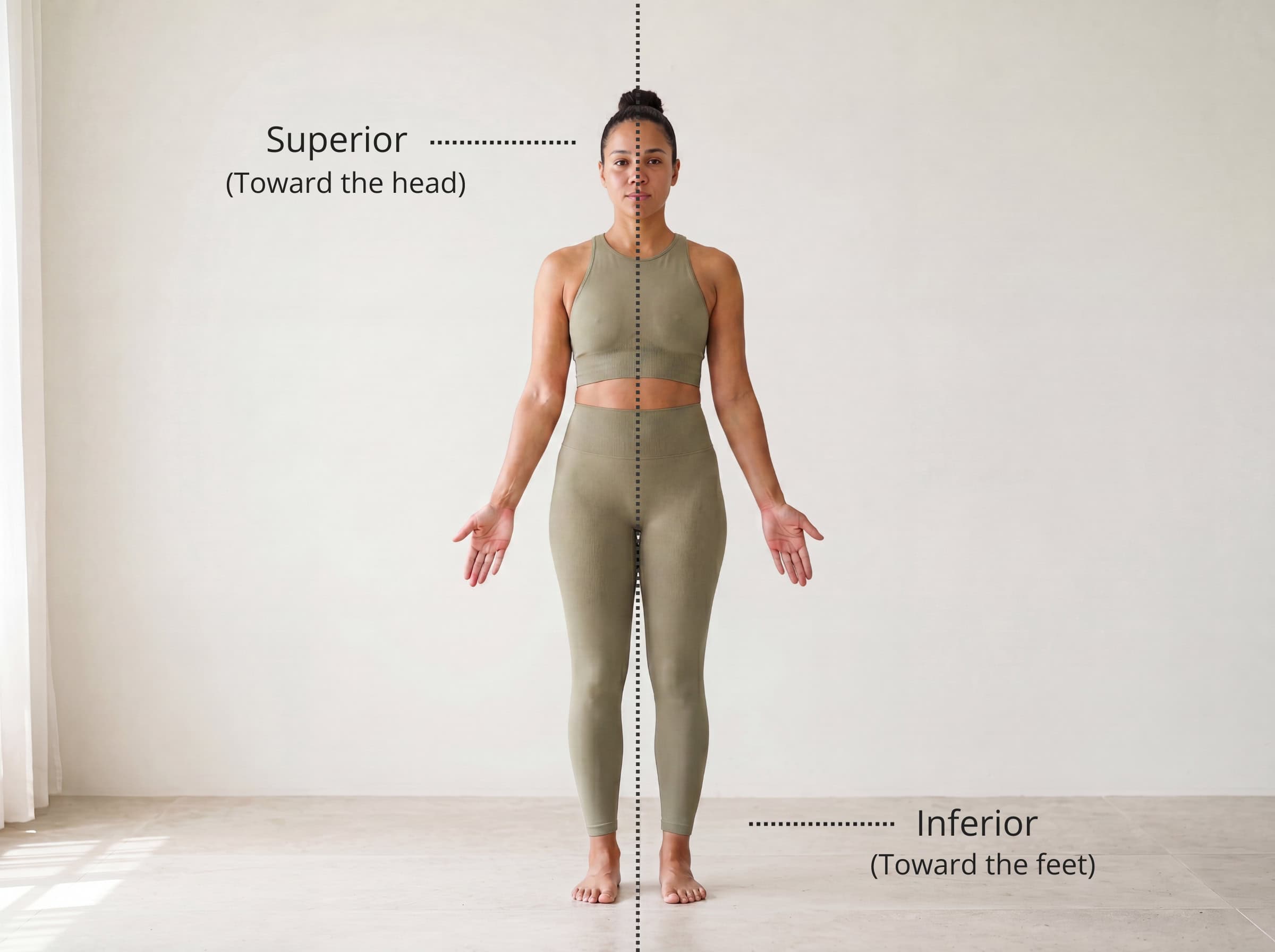
Run a finger from the tip of your nose down to your throat: your chin is inferior to your nose (further toward your feet) and superior to your throat (closer to your head). The same body part can be both superior and inferior depending on what you are comparing it to.
Superior means toward the head or toward the feet?
Toward the head. Inferior = toward the feet.
Proximal / Distal
Directional pair 4 of 4
Proximal — closer to the trunk of the body.
Distal — further from the trunk of the body.
Yoga asana example: The proximal hamstring attaches at the sitting bone. The distal hamstring attaches below the knee. Most hamstring injuries in yoga happen at the proximal end, where the tendon attaches at the ischial tuberosity.
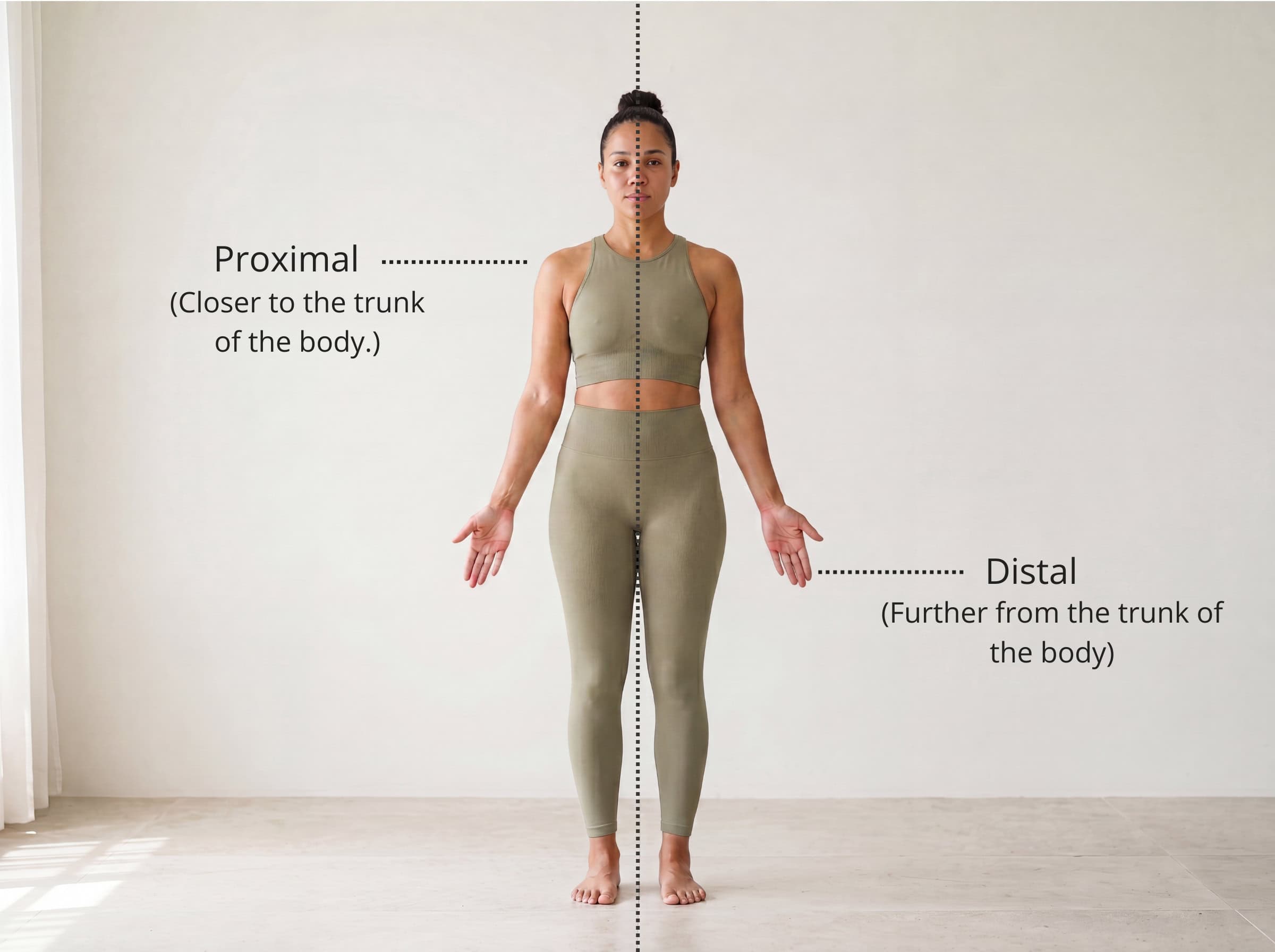
Touch your elbow, then your wrist. Your elbow is proximal — closer to the trunk. Your wrist is distal — further away. Now try it on your leg: touch your knee and then your ankle. Which is proximal?
Proximal or distal: which is closer to the trunk?
Proximal. Distal = further away.
Module 2 Quiz
8 questions · directional pairs
Module 3: Movement Terms at Joints
Thirteen terms. Each one names a movement at a joint. Once you've learned these you'll be able to describe yoga movements anatomically.
You'll cover seven screens of definitions, then a short quiz. Each screen has a practice prompt to test yourself.
You are already using most of these in class. "Bend your knee," "straighten your leg" and "flex your foot" are movement terms. Knowing the precise names is helpful in a few ways; For example, when a student brings you a physio note that says "avoid hip flexion past 90 degrees" you need to know which poses that affects. It may be helpful if you refer a student on and need to describe what is aggravating their issue (without diagnosing e.g. they seem to experience pain when flexing the hip). These terms are also useful for your own sequencing: once you can name the movements you can start to see which ones you offer and which ones you skip and need to add more of to balance out your class.
Flexion / Extension
Movement term 1 of 7
Flexion — decreasing the joint angle.
Extension — increasing the joint angle.
Yoga asana example: Folding forward flexes the hip and spine. A backbend extends them. At the knee, flexion means bending it (Utkatasana (Chair Pose)). Extension means straightening it. Same words, opposite-looking movements depending on which joint you are at.
A note on the spine: in spinal flexion the anterior (front) surfaces of the vertebrae compress together and the posterior surfaces gap apart, which is the forward rounding you see in a fold. In extension it reverses: posterior surfaces compress and the anterior surfaces open up.
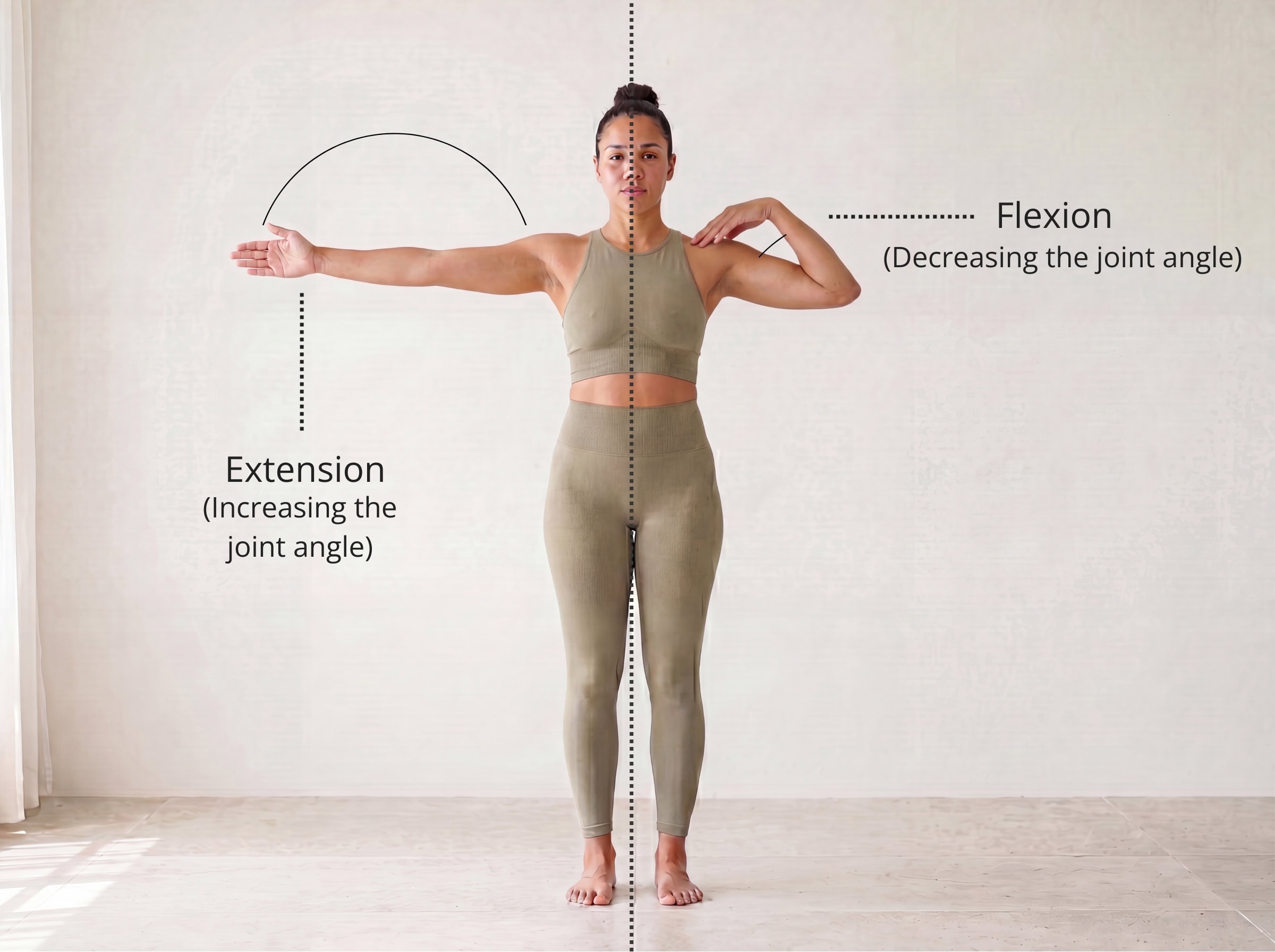
Sit in a chair and bend your knee, drawing your heel toward you. That is flexion at the knee. Now straighten the leg. Extension. Stand up and fold forward slowly. Feel your hip angle close. Flexion. Lift back to standing. Extension.
In Setu Bandha Sarvangasana (Bridge Pose), the hip is in flexion or extension?
Extension. In Setu Bandha Sarvangasana (Bridge Pose) the hips lift away from the floor and the hip angle opens. The joint angle increases, which is extension. Folding forward is flexion. Lifting the hips up and back is extension.
Abduction / Adduction
Movement term 2 of 7
Abduction — moving a limb away from the midline.
Adduction — moving a limb toward the midline.
Yoga asana example: Stepping into Virabhadrasana II (Warrior II) takes the legs into abduction. The inner-thigh engagement in Tadasana (Mountain Pose) is adduction effort.
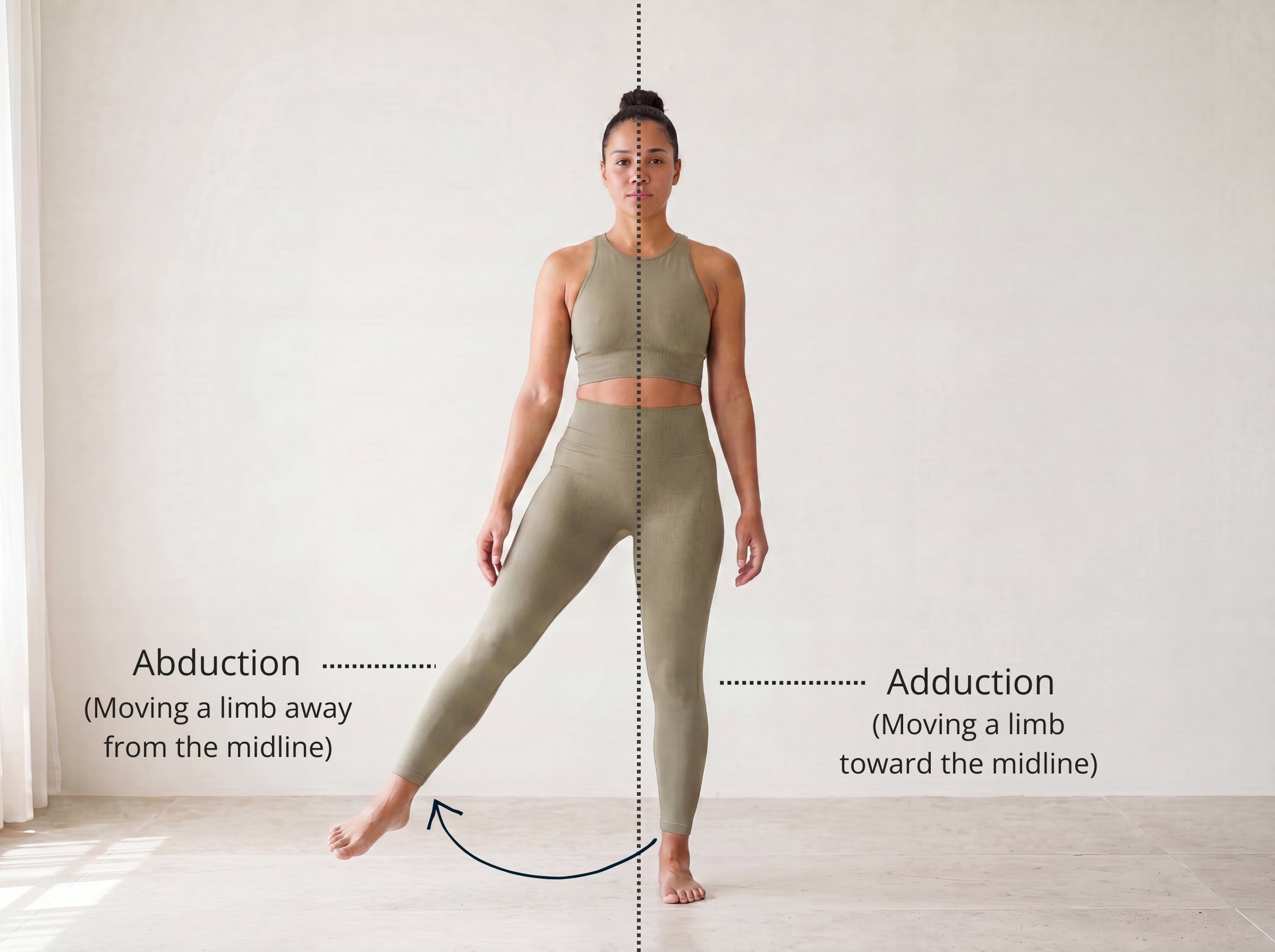
Stand in Tadasana (Mountain Pose). Step one foot wide to the side. That is abduction. Now draw it back in. Adduction. When standing in Virabhadrasana II (Warrior II), you've abducted your legs forward. Shift back to Tadasana by adducting your legs.
Which brings a limb toward the midline: abduction or adduction?
Adduction. Abduction takes it away.
Medial / Lateral Rotation
Movement term 3 of 7
Medial rotation (also called internal rotation) — rotating a limb toward the midline.
Lateral rotation (also called external rotation) — rotating a limb away from the midline.
Yoga asana example: When you hear "Open your hip" in a class, the teacher is typically referring to lateral/external rotation of the femur. "Toes forward" encourages a more neutral or slightly medial/internal femoral rotation.
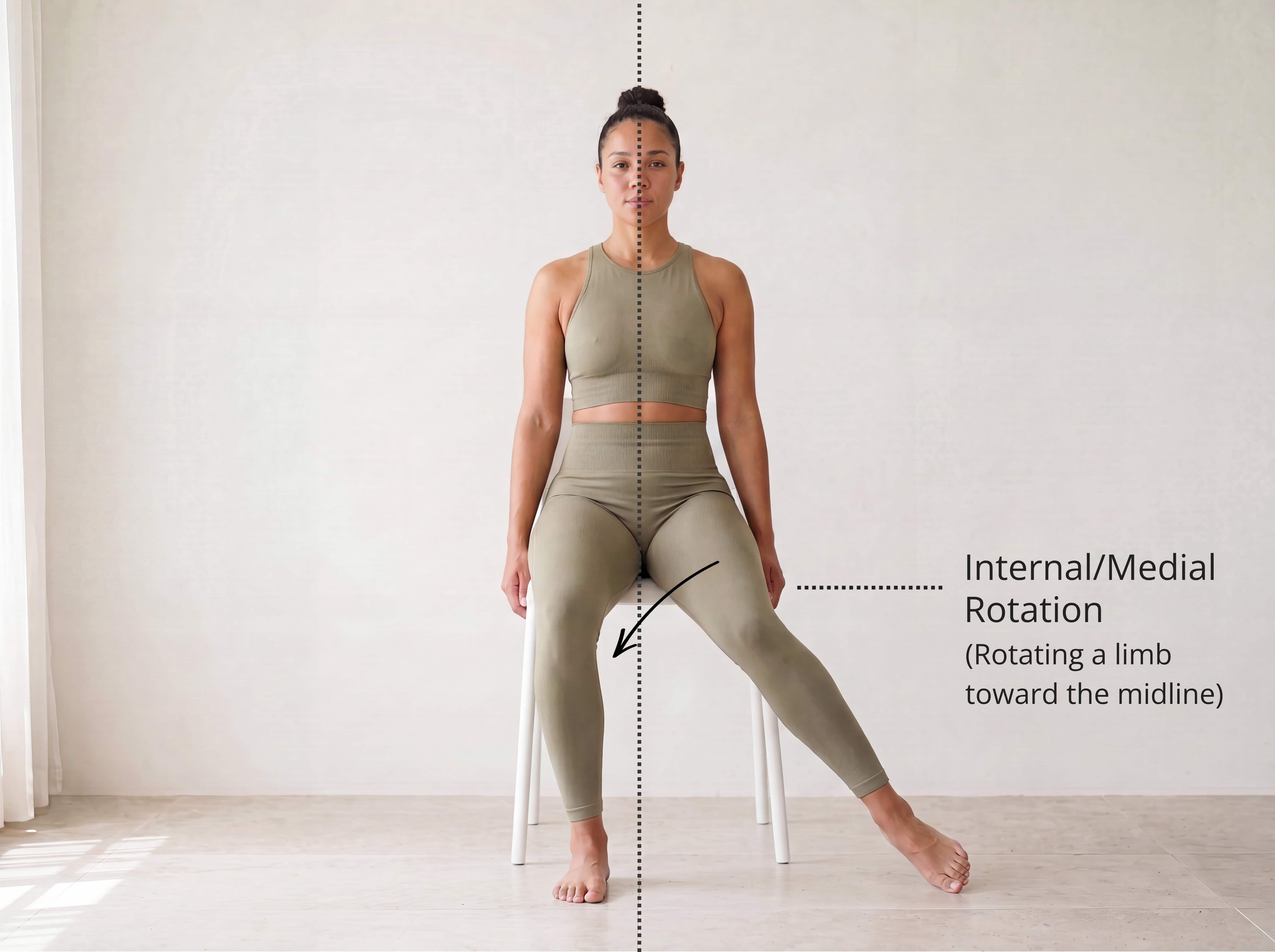
Medial (internal) rotation
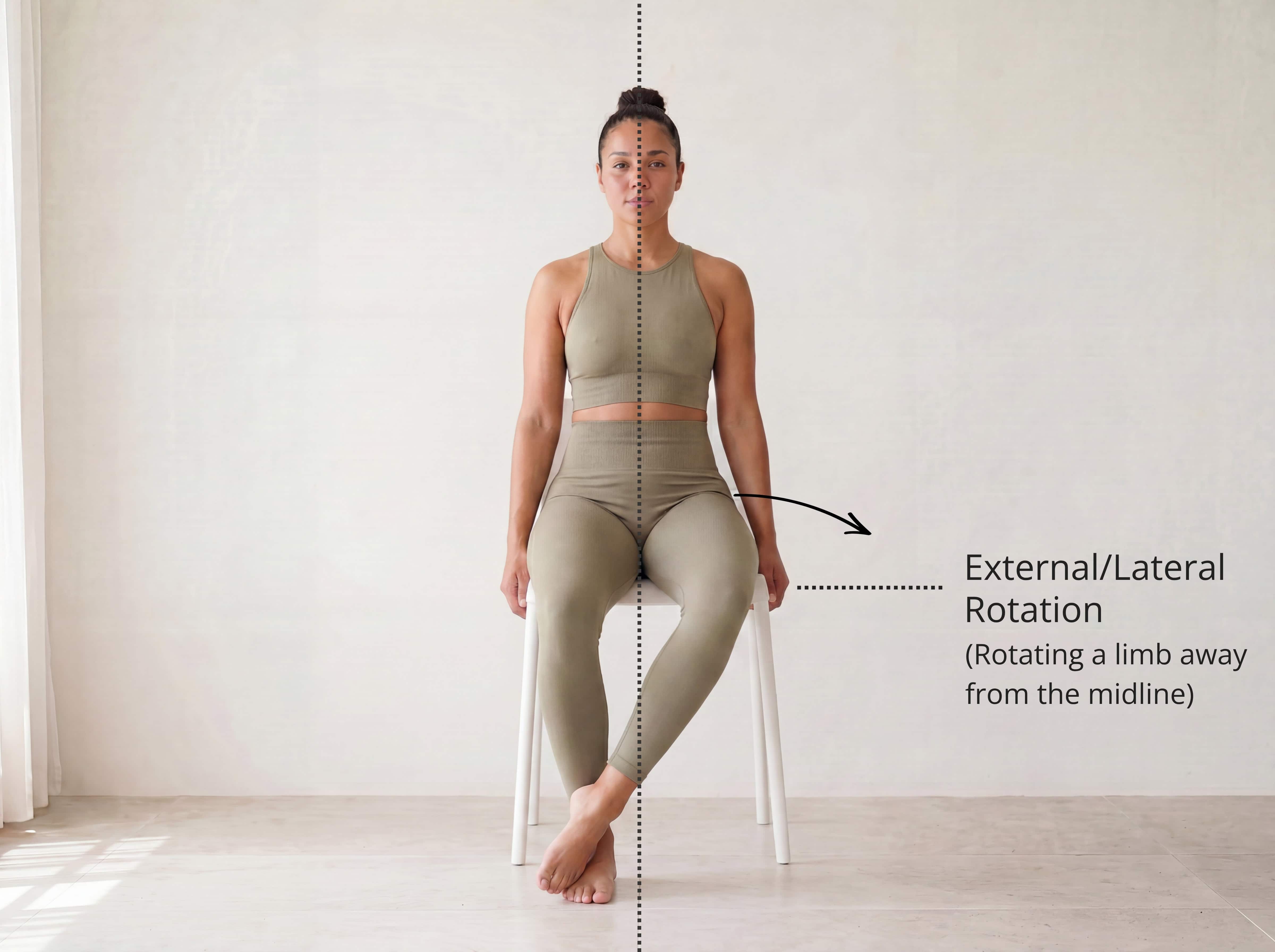
Lateral (external) rotation
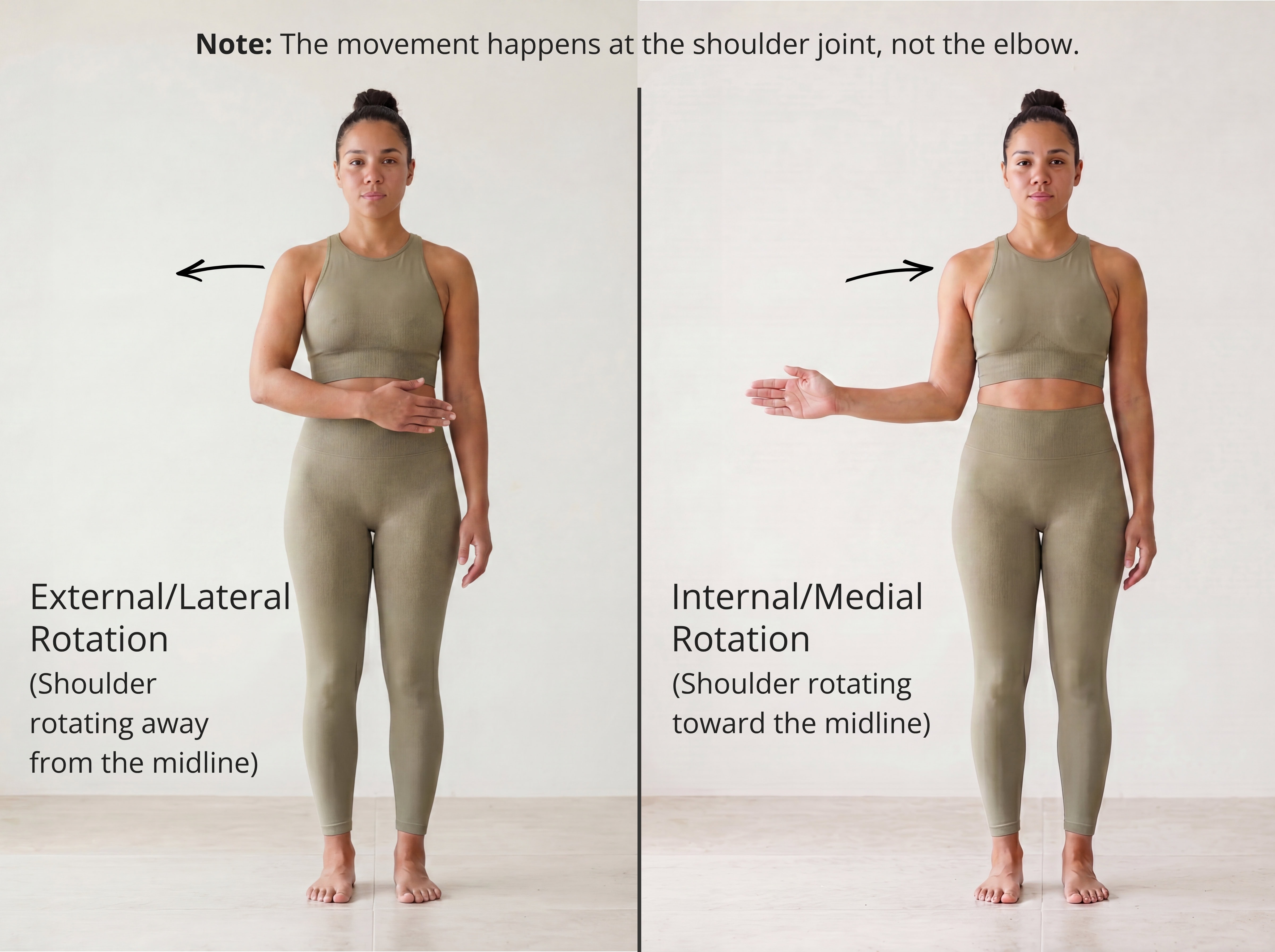
Shoulder — medial (internal) rotation
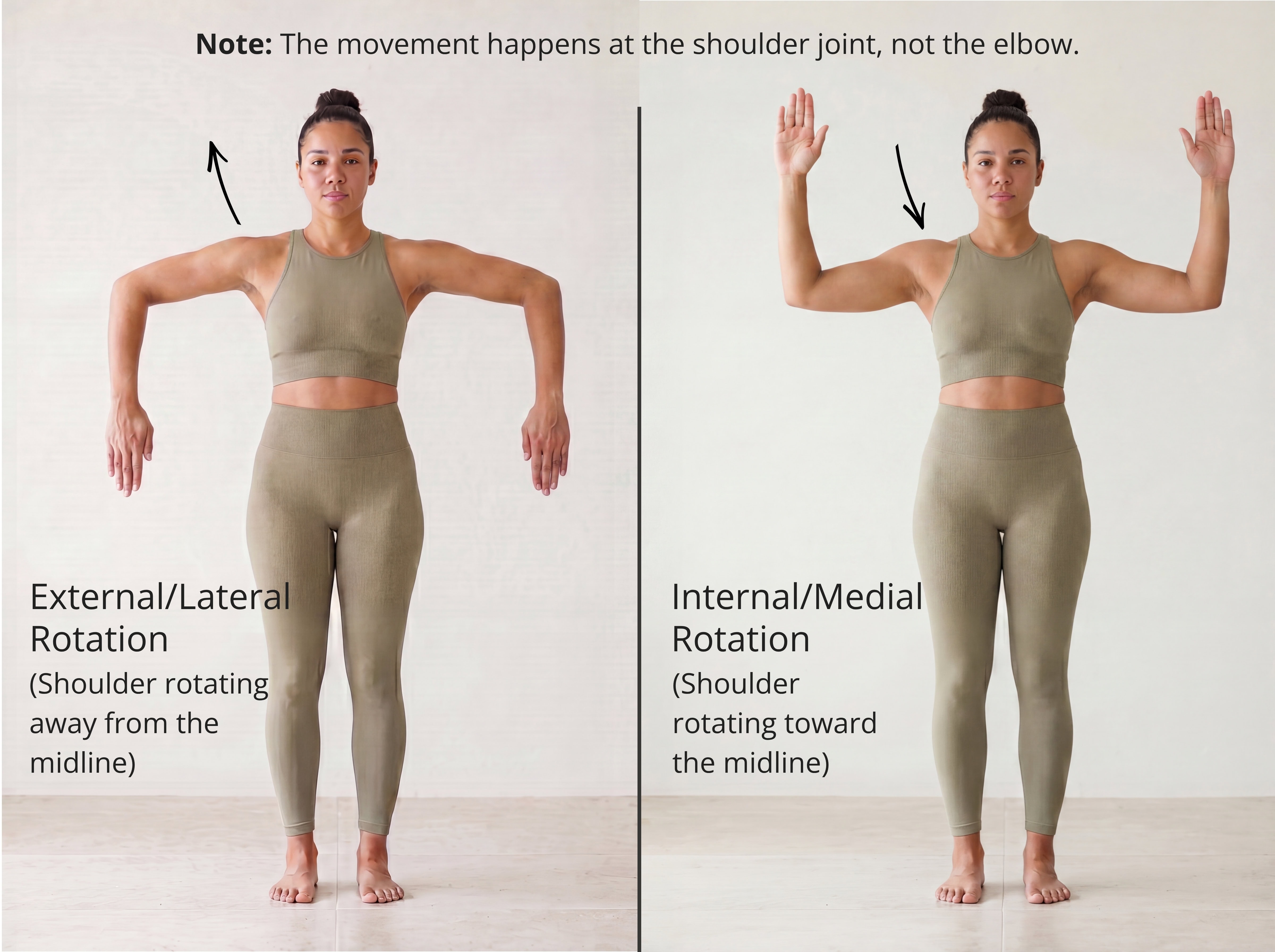
Shoulder — lateral (external) rotation
Why this one feels counter-intuitive
Internal and external rotation can sometimes feel counter-intuitive because both terms are always measured from anatomical position: the body standing upright, arms at the sides, palms facing forward. It can be easier to understand once you feel it in your body.
For example, when we rotate the hip inward (medial rotation) the glute and heel tend to shift away from the midline, as shown in the first image above. This can make it seem like external rotation, but the focus should be on what the hip joint and femur are doing rather than the limb as a whole. Notice how the knee shifts toward the midline. Similarly in external rotation, the heel shifts in but the movement at the hip joint is away from the midline.
The shoulder can be equally confusing. Check the diagrams above and carefully note where the arrows go. The arm can move away but the joint itself moves in.
This is further complicated in yoga asanas, as we are not shifting from one asana to the next starting in anatomical position each time and what's happening for each student may be different depending on their body and joint structure. Take Virabhadrasana II (Warrior II) for example: the front hip can be in internal, neutral or external rotation depending on the student's anatomy and foot placement, while the back leg tends to be externally rotated when the student's foot is at 90°. No rotation is wrong; it's just different and something to keep in mind when we try to cue people into a "correct" formation. What looks "correct" may not feel right and internally may be doing something different to what you expect based on textbook anatomy.
Sit on a chair with feet flat on the floor. Without moving your feet, try to rotate your thighs inward so your knees drop toward each other. Medial rotation. Now rotate them outward so knees move apart. Lateral rotation. Notice how your pelvis responds to each.
"Open your hip" cues medial or lateral rotation of the femur?
Lateral rotation (external rotation). The femur turns away from the midline.
Lateral Flexion
Movement term 4 of 7
This applies to the spine.
Lateral flexion — bending the spine to one side.
This is the anatomical term for what teachers commonly call a "side bend."
Yoga asana example: Parighasana (Gate Pose), Utthita Parsvakonasana (Extended Side Angle) and any side stretch of the spine involve lateral flexion. Most vinyasa classes include far fewer side bends than forward folds or backbends.
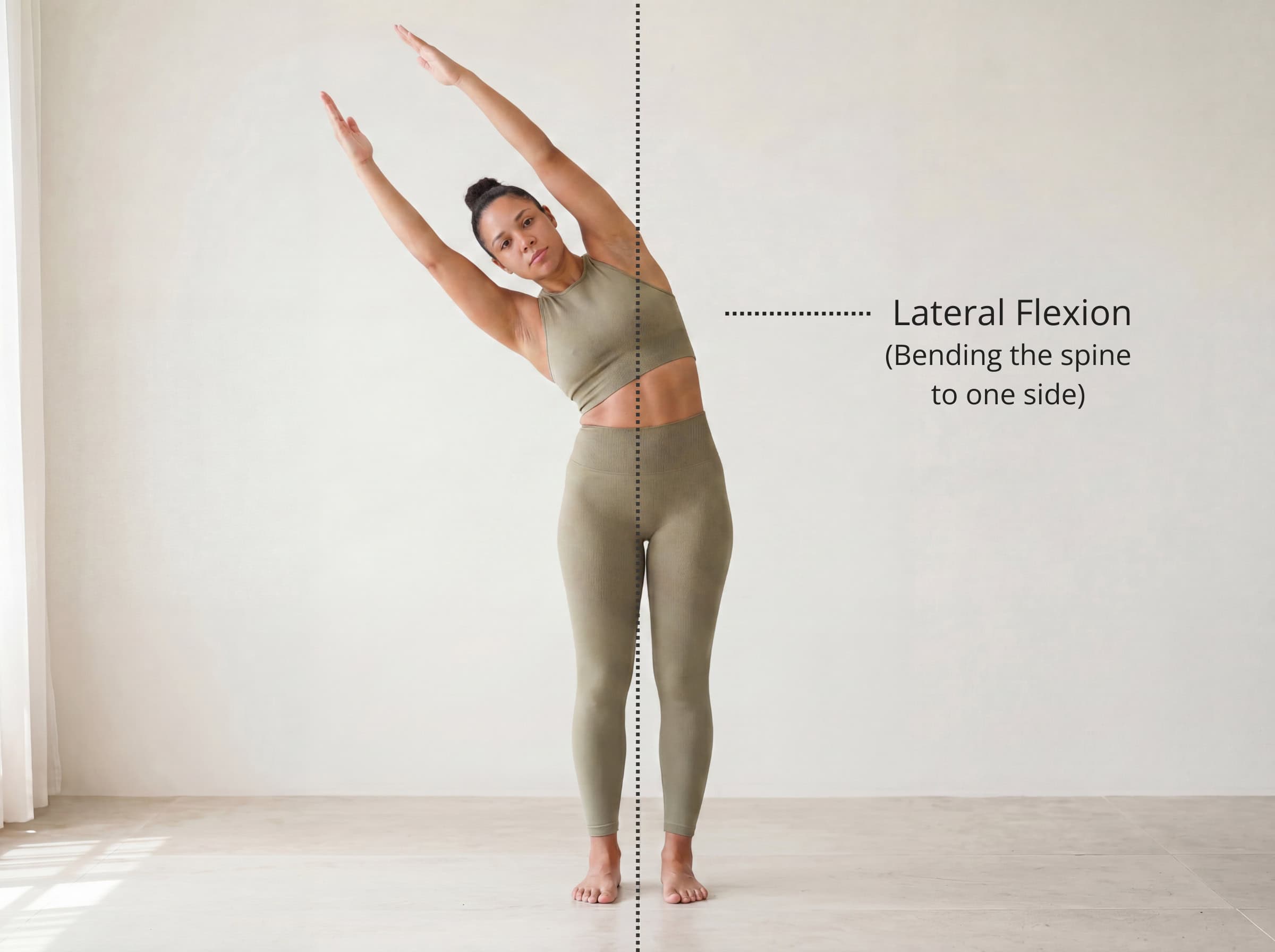
Stand in Tadasana (Mountain Pose). Reach both arms overhead, palms facing each other. From there, slowly bend your torso to the left, keeping both arms alongside your ears into Parsva Urdhva Hastasana (Upward Salute Side Bend). Feel the right side of your ribcage lengthen and the left side compress. That is lateral flexion of the spine to the left. Return through centre and repeat to the other side.
What is the anatomical term for a side bend of the spine?
Lateral flexion. The spine bends toward one side in the frontal plane.
Supination / Pronation
Movement term 5 of 7 · forearm
These apply to the forearm.
Supination — palms face up or forward.
Pronation — palms face down or back.
Yoga asana example: In anatomical position, the forearm is supinated (palms forward). In Adho Mukha Svanasana (Downward Dog), the forearm is pronated (palms face the mat).
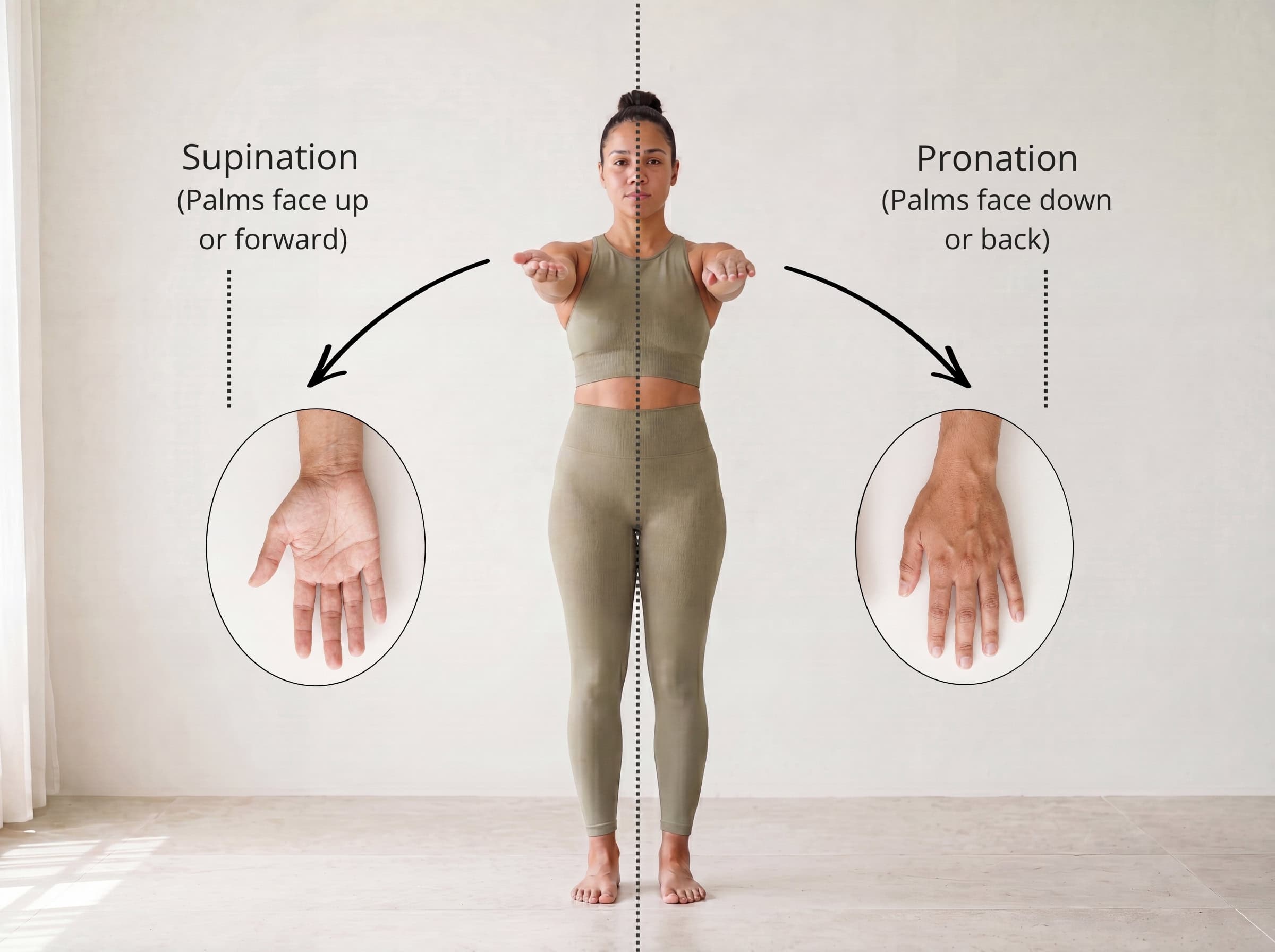
Hold your arm out in front of you, elbow bent to 90 degrees. Rotate your forearm so the palm faces up. Supination. Now rotate so the palm faces down. Pronation.
In Adho Mukha Svanasana (Downward Dog), press your palms flat and notice your forearms are pronated throughout the asana.
In Navasana (Boat Pose) with arms extended and palms facing up, are your arms in supination or pronation?
Supinated. Palms face up.
Dorsiflexion / Plantarflexion
Movement term 6 of 7 · ankle
These apply to the ankle.
Dorsiflexion — the top of the foot moves toward the shin. Foot "flexed."
Plantarflexion — the foot points away from the shin. Foot "pointed."
Yoga asana example: "Flex your foot" cues dorsiflexion. "Point your toes" cues plantarflexion. In Adho Mukha Svanasana (Downward Dog), the ankle is in dorsiflexion when the heel drops toward the mat. In any seated asana with a pointed foot, the ankle is in plantarflexion.
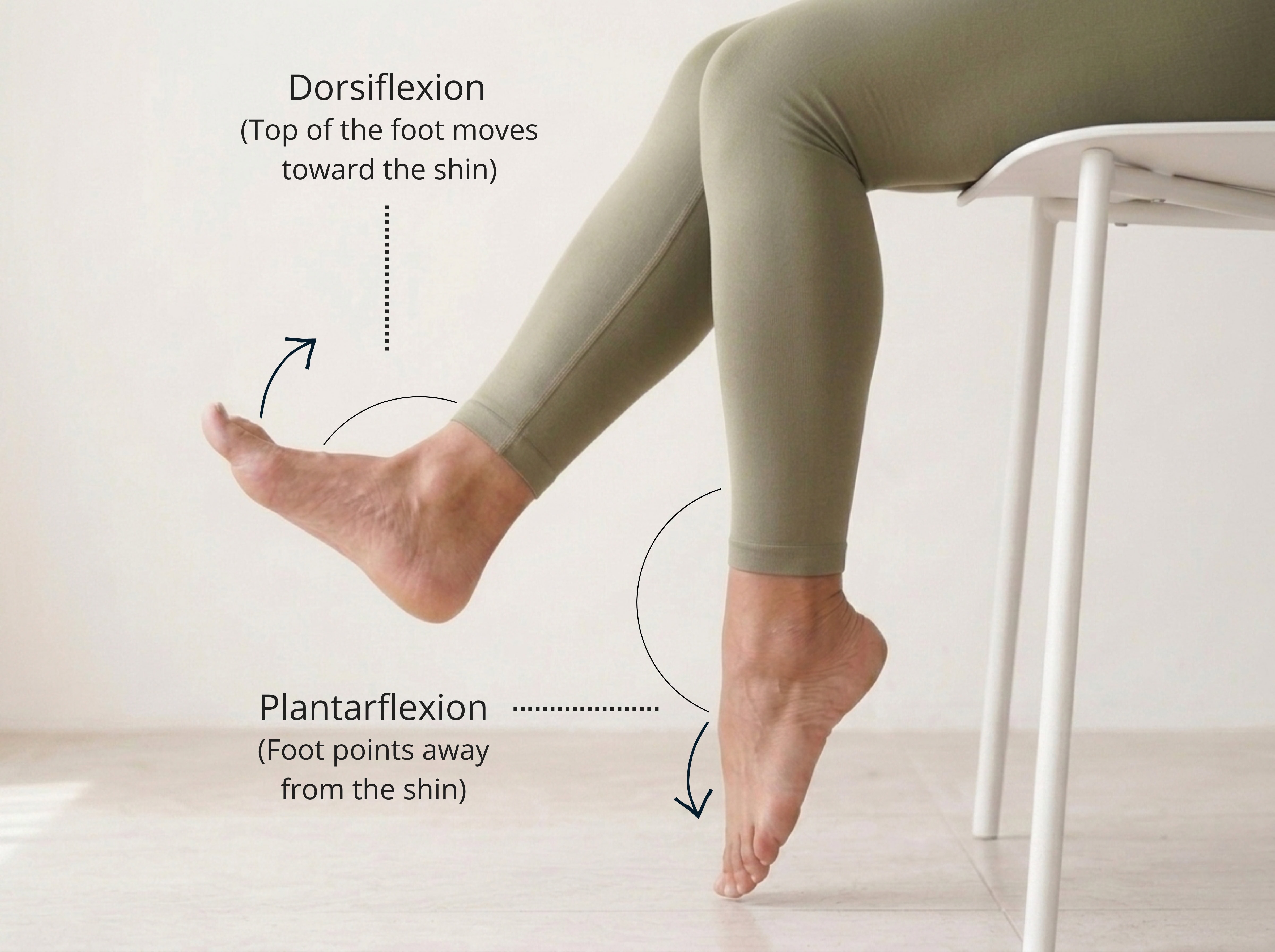
Sit on the floor with your legs extended. Point your toes and imagine you're trying to get them to touch the ground so they can plant into the earth. This is plantarflexion. Now flex your feet towards your shins, picturing your toes like little fish fins facing up. This is dorsiflexion.
In Balasana (Child's Pose), the tops of the feet rest on the mat with toes pointing away. Is that dorsiflexion or plantarflexion?
Plantarflexion. The toes point away from the shin.
Eversion / Inversion
Movement term 7 of 7 · foot
These apply to the foot.
Eversion — the sole turns outward away from the midline.
Inversion — the sole turns inward toward the midline.
Real world context: Rolling the ankle outward is eversion. Rolling it inward is inversion. Most ankle sprains happen in inversion. The foot rolls in and the outer structures are stretched. The majority of ankle sprains tend to be inversion type.
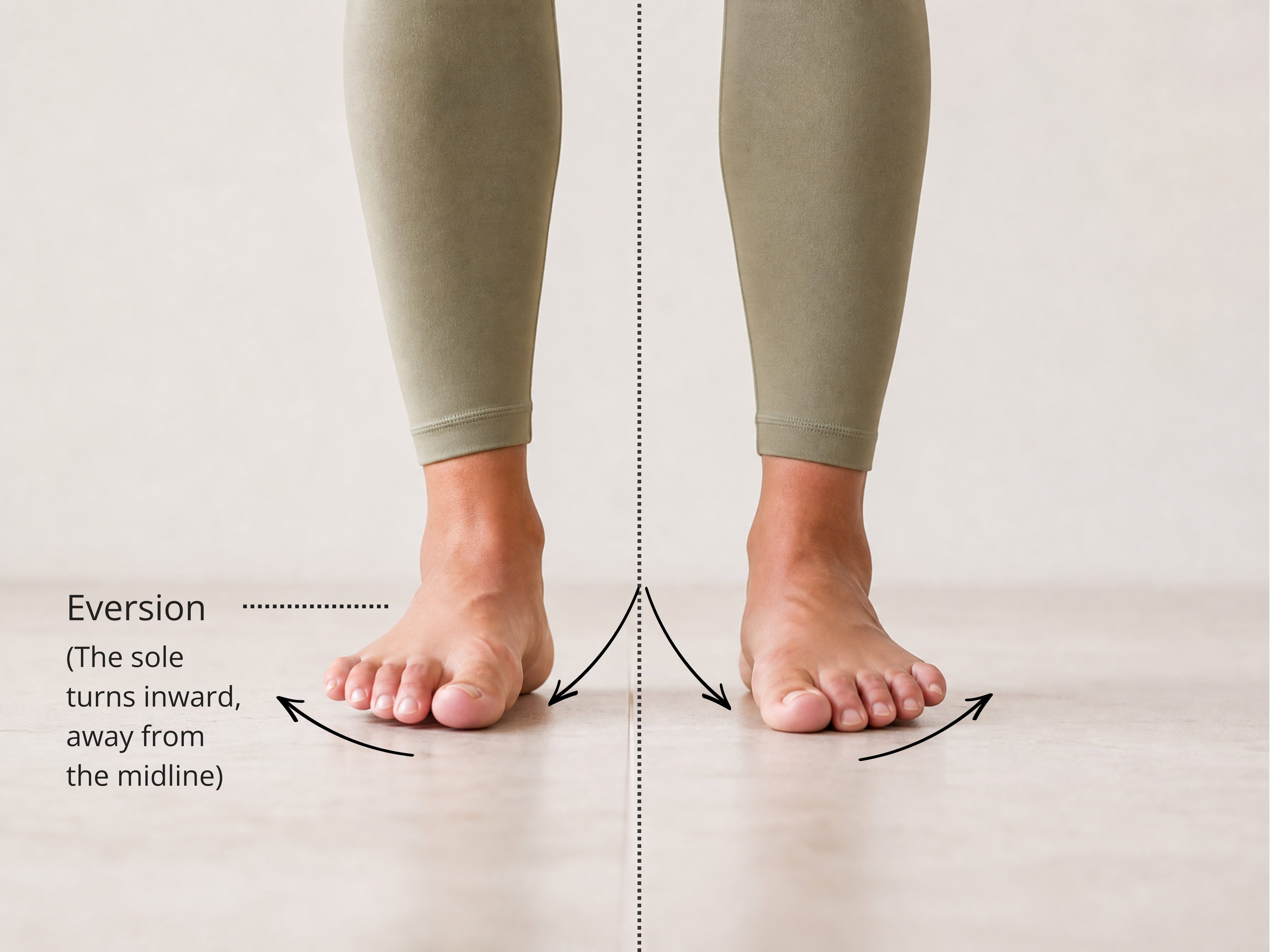
Eversion — sole turns outward away from the midline
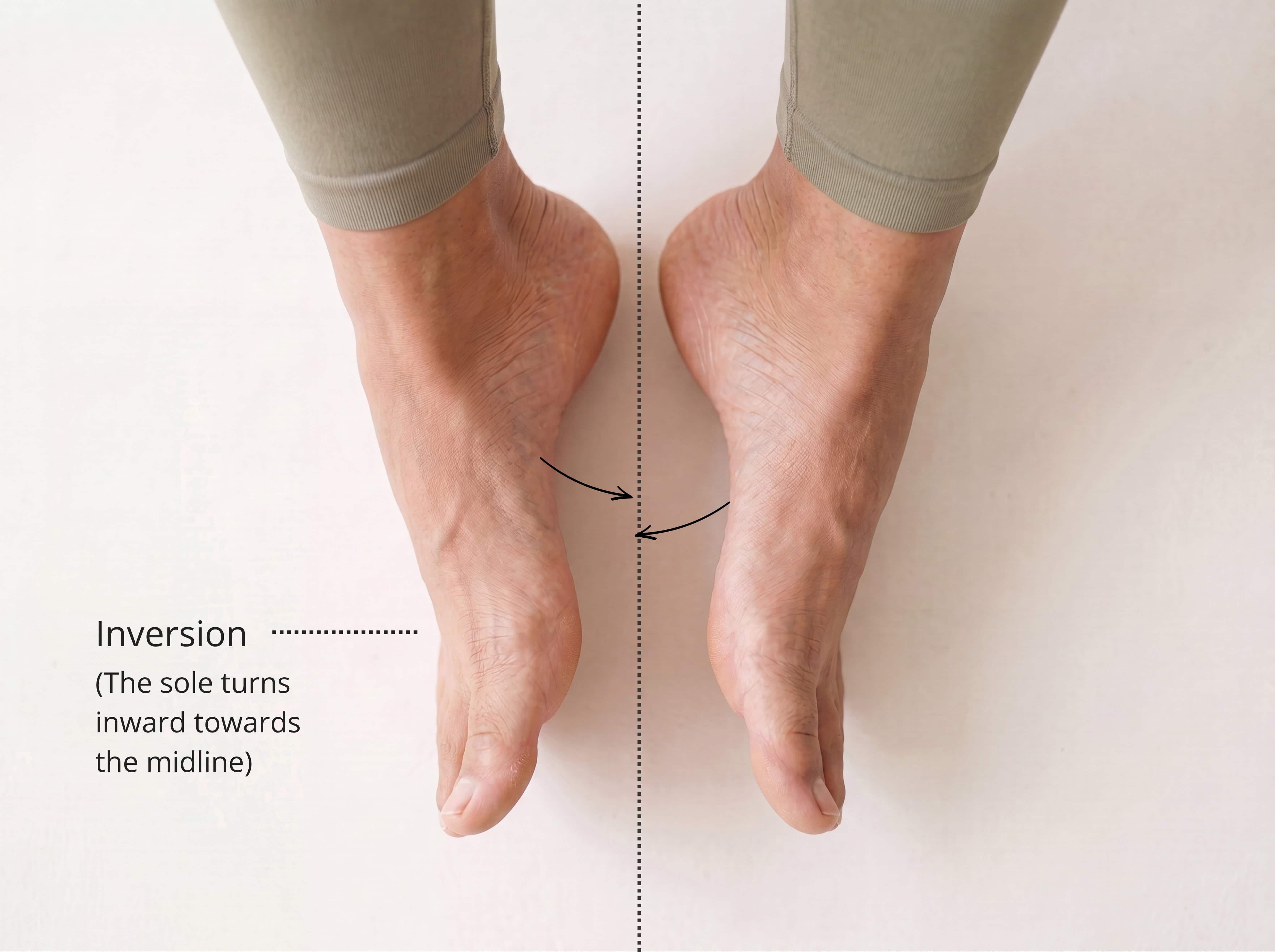
Inversion — sole turns inward toward the midline
Sit on the floor with legs extended. Slowly roll both ankles so the soles face outward. Eversion. Now roll them inward so the soles face each other. Inversion. Notice how little range is available in eversion compared to inversion. That asymmetry is part of why inversion sprains are so common.
When cued to press down through the outer edge of the back foot in Virabhadrasana II (Warrior II), is that encouraging inversion or eversion?
Inversion. Pressing through the outer edge turns the sole inward toward the midline.
Module 3 Quiz
14 questions · movement terms at joints
Module 4: Three Planes of Motion
Every movement your students make happens in one of three planes. Most asanas touch more than one, but each has a primary plane. When you map your classes by plane, a pattern tends to emerge: most yoga asana practices are heavily sagittal. That matters because the body is designed to move in all three. Daily life already gives us plenty of sagittal movement: walking, sitting and reaching forward. The frontal and transverse planes work different muscles and joints: lateral stability, rotational strength and the deep hip stabilisers. A class that skips them consistently leaves those tissues underworked, which they already tend to be from our daily activities. Once you can name the planes, you can see where your gaps are and start to fill them so your students build strength and mobility in these typically underused areas.
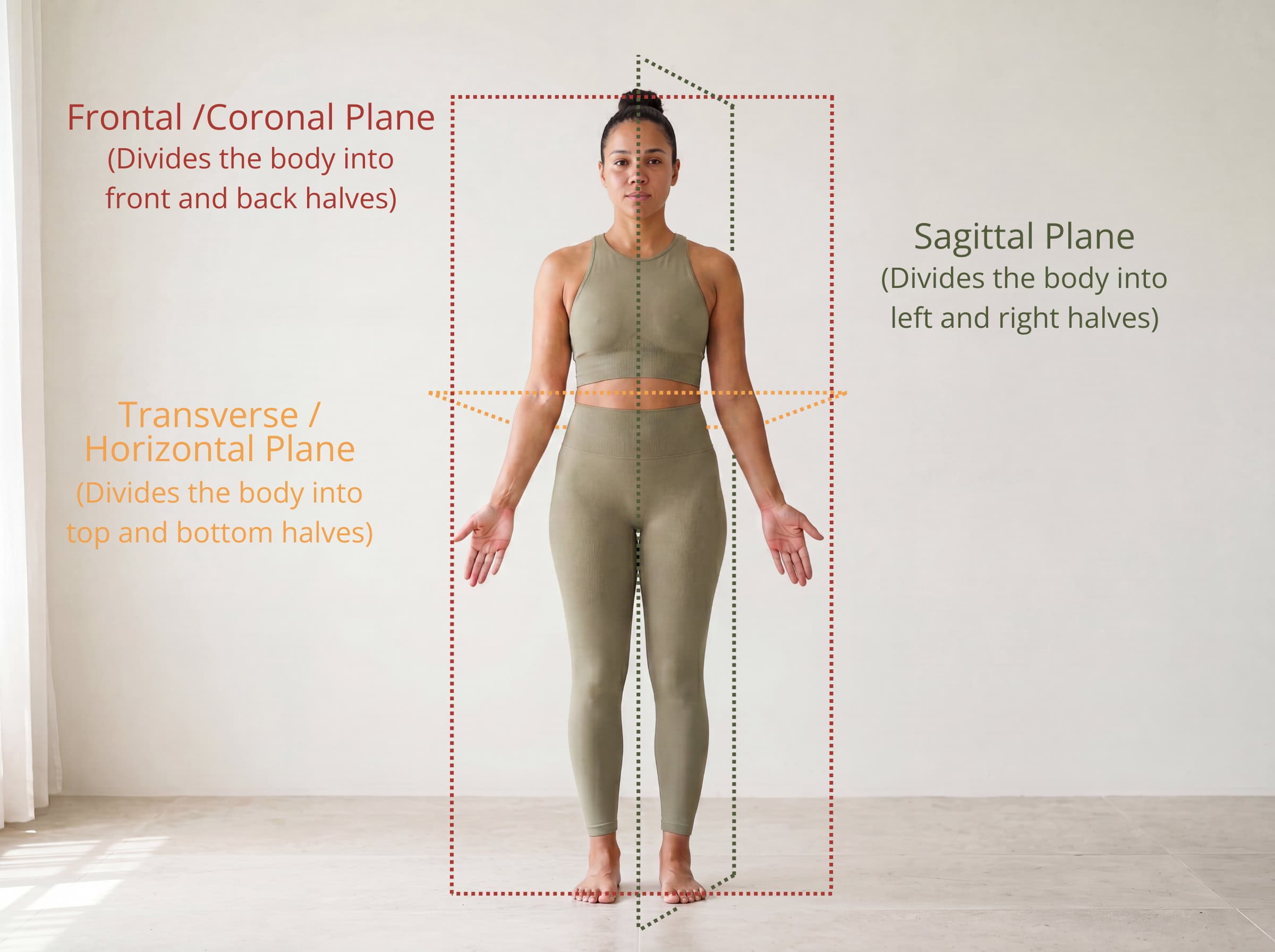
You'll cover three definition screens, a plane-mapping activity with six asanas and finish with a quiz.
Sagittal Plane
Plane 1 of 3
The sagittal plane divides the body into left and right halves. The primary movements in this plane are flexion and extension.
Yoga asana example: Surya Namaskar (Sun Salutations), forward folds and backbends are primarily sagittal. This is the dominant plane in most vinyasa practice.
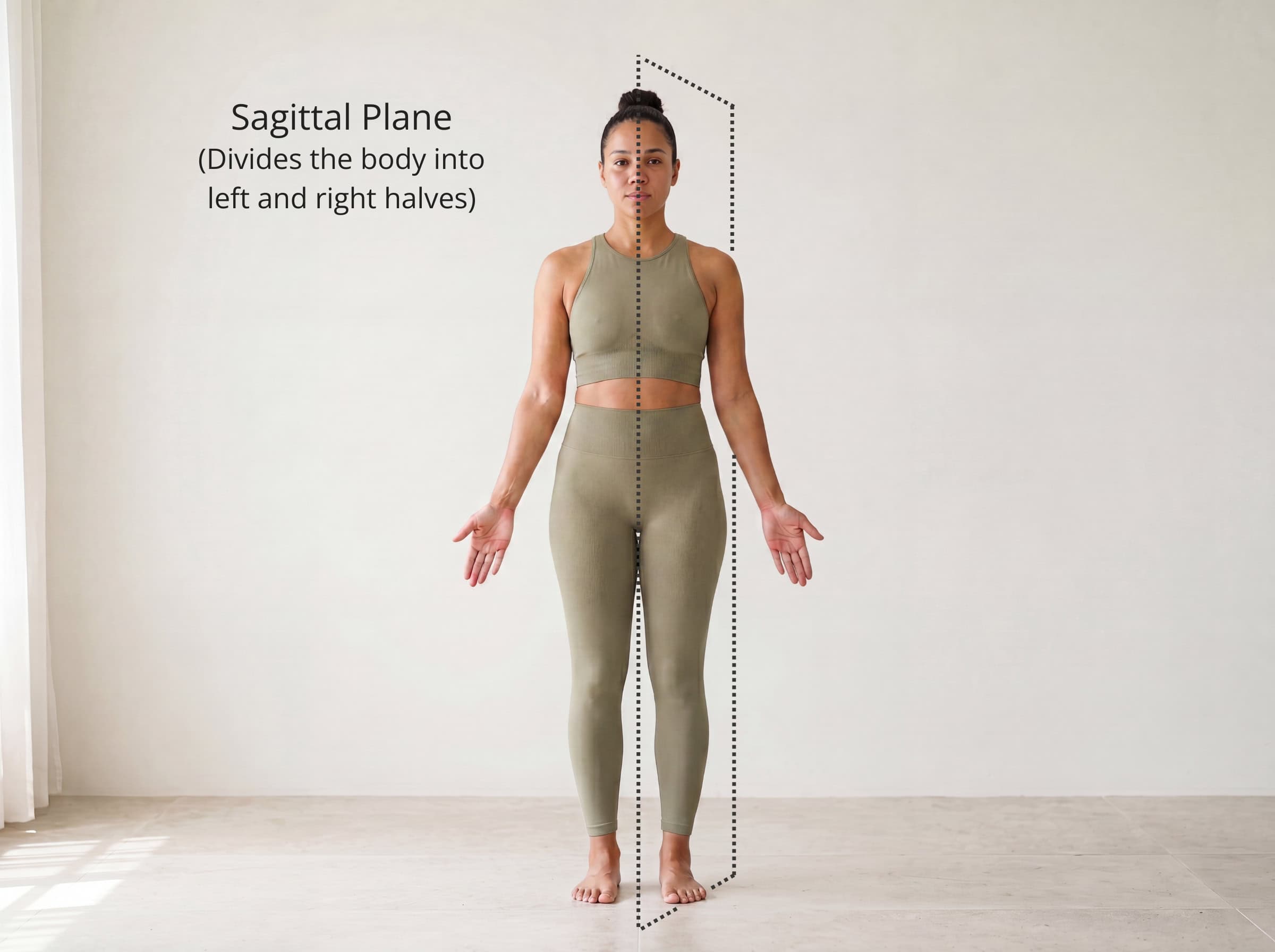
Stand and do a slow forward fold, then return upright, then a gentle backbend. Feel the movement: it all travels forward and back through a single plane. That is the sagittal plane.
Ustrasana (Camel Pose) takes the spine into deep extension. Which plane is that?
Sagittal. Extension, like flexion, travels forward and back through the sagittal plane. Backbends and forward folds are both sagittal movements.
Frontal / Coronal Plane
Plane 2 of 3
The frontal plane (also called the coronal plane) divides the body into front and back halves. The primary movements in this plane are abduction, adduction and lateral flexion.
Yoga asana example: Utkata Konasana (Goddess Pose), Trikonasana (Triangle Pose) and side bends are primarily frontal plane movements. Most classes give this plane far less time than the sagittal.
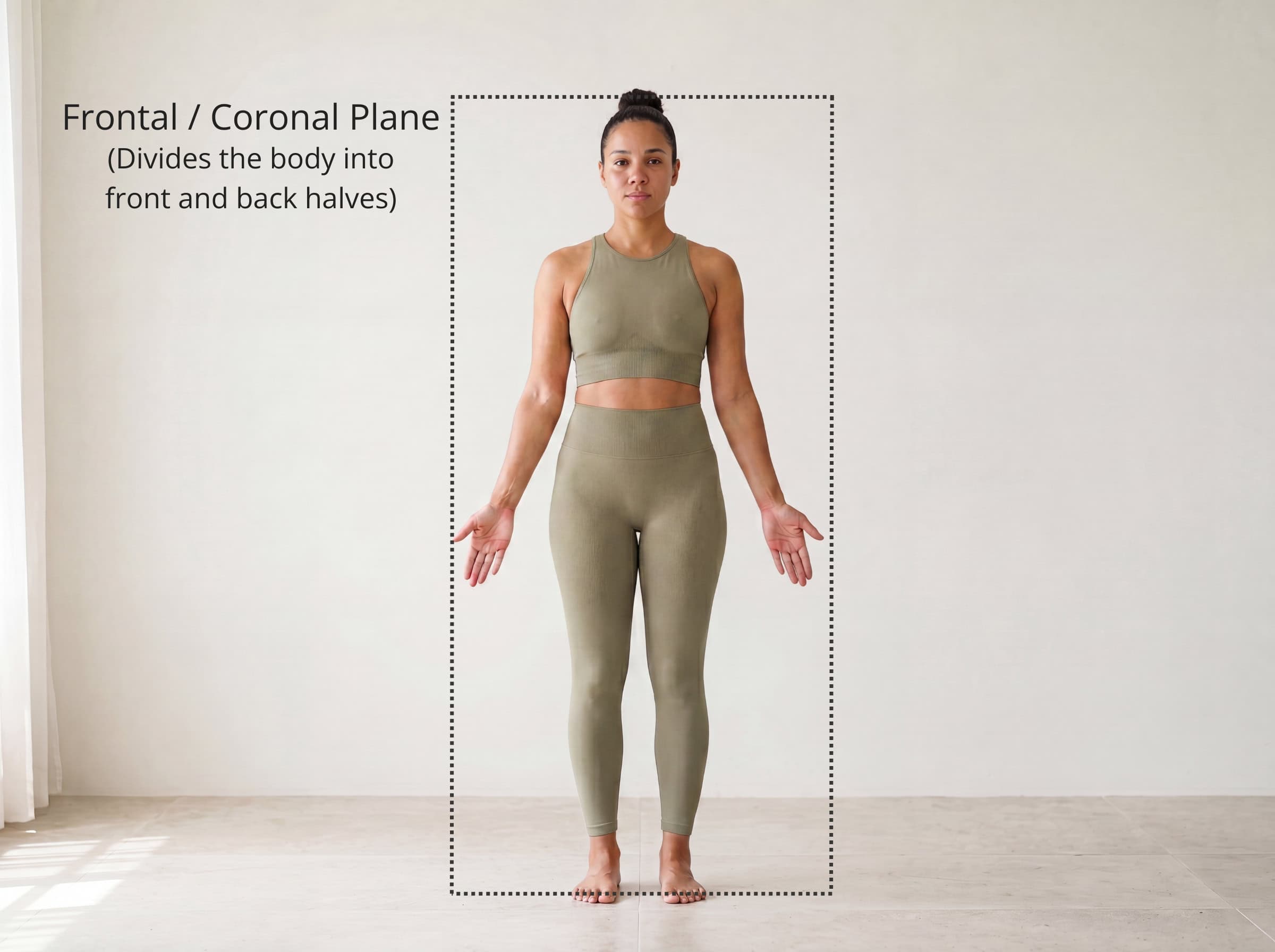
Stand in Tadasana (Mountain Pose). Step one foot wide to the side, arms out to a T shape. Feel the movement open sideways rather than forward and back. That is frontal plane movement. Now do a standing side bend. Same plane, different movement.
Utthita Parsvakonasana (Extended Side Angle) involves lateral flexion of the spine and abduction of the legs. Which plane is that?
Frontal (also called coronal). Lateral flexion and abduction are both frontal plane movements. Anything that travels side to side is frontal.
Transverse / Horizontal Plane
Plane 3 of 3
The transverse plane (also called the horizontal plane) divides the body into top and bottom halves. The primary movement in this plane is rotation.
Yoga asana example: Twists happen in the transverse plane. Parivrtta Trikonasana (Revolved Triangle), seated twists, any rotation of the spine. This plane tends to get the least time in most sequences.
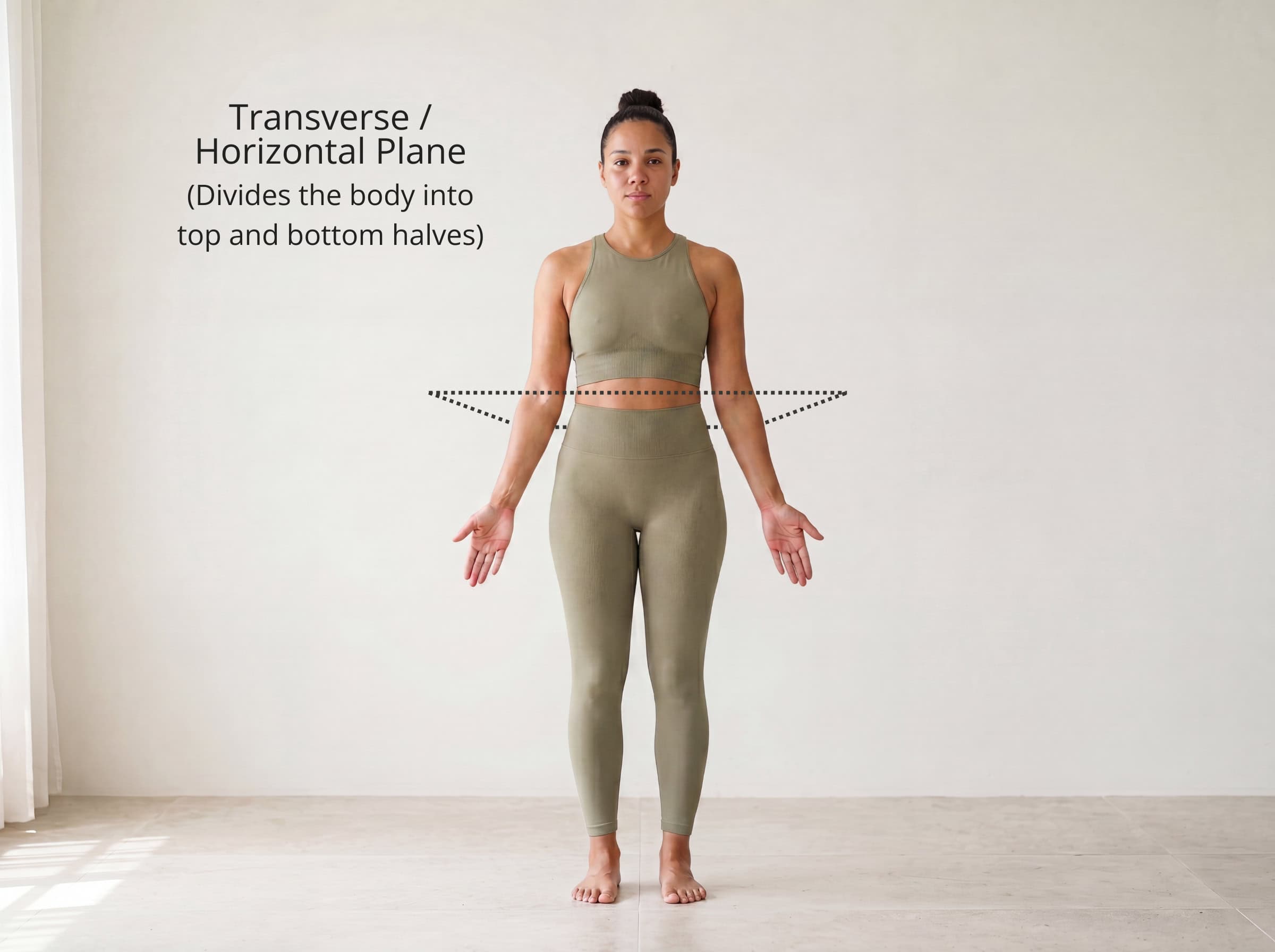
Think of any spinal twist in your teaching: Parivrtta Utkatasana (Revolved Chair), Ardha Matsyendrasana (Half Lord of the Fishes), even a simple supine twist. The rotation happens around a vertical axis running through the spine. That is the transverse plane. Try your favorite twist and notice the sensation this shape creates in your body.
Parivrtta Utkatasana (Revolved Chair Pose) involves rotating the spine while in a deep squat. Which plane does that rotation happen in?
Transverse (also called horizontal). Spinal rotation always happens in the transverse plane, regardless of the base shape the legs are in.
Plane Mapping
The OMG moment · six asanas
Here are six asanas you have not labelled yet. For each one, try it in your body first, then decide: which is its primary plane of motion?
Module 4 Quiz
5 questions · planes of motion
Final Review Quiz
20 questions · all four modules · ~5 minutes
This final quiz contains questions from all of the content in this study guide. It's designed to help you review and practice retrieving the content.
Well Done! You Made It to the End
Three layers of anatomical vocabulary, tested three times. Here is what you covered and what to do next to make it stick.
What you covered
Directional terms: anterior, posterior, medial, lateral, superior, inferior, proximal and distal. The eight terms that let you describe any location on the body precisely.
Movement terms: flexion, extension, abduction, adduction, medial and lateral rotation, lateral flexion, supination, pronation, dorsiflexion, plantarflexion, eversion and inversion. The thirteen terms that name what every joint in a yoga class is actually doing.
Planes of motion: sagittal, frontal and transverse. The three planes your students move through and the pattern that shows up when you map your own sequences.
Run it through your body
You know this vocabulary, you just need to practise saying the words. Do this 3-minute body mapping exercise once a day for a week, then every few days when you remember and these terms will become automatic.
Remember: pair them up, so instead of trying to remember 25 terms you just need to recall 4 directional terms (and then their opposite), 7 movement terms (6 have an opposite) and 3 planes of motion (25 terms become 4+7+3, plus anatomical position).
The first few times, physically run through it: say the terms out loud, touch the places on your body and make the movement. Later, you can quickly run through the body map in your head. Start by standing up, eyes open or closed.
STEP 1 — SET THE REFERENCE
Stand upright, feet roughly parallel, palms facing forward. Say out loud: "Anatomical position." This is the starting point every term is measured from.
STEP 2 — 4 PAIRS OF DIRECTIONAL TERMS
Touch or visualise each body part as you say its term:
Top of your head → "Superior."
Your feet → "Inferior."
Front of your chest → "Anterior."
Your spine → "Posterior."
Inner thigh → "Medial."
Outer thigh → "Lateral."
Your shoulder → "Proximal" (close to the trunk).
Your fingertips → "Distal" (further from the trunk).
STEP 3 — 7 PAIRS OF MOVEMENT TERMS
Perform each movement as you say its name:
Bend your elbow → "Flexion."
Straighten it → "Extension."
Lift your arm out to the side → "Abduction."
Bring it back in → "Adduction."
Rotate your right knee so it faces your left knee, heel kicks out → "Medial rotation."
Rotate your right knee so it faces away from your body → "Lateral rotation."
Bend your spine to one side → "Lateral flexion."
Turn your palms to face up like you're holding a bowl of soup → "Supination."
Turn them to face down → "Pronation."
Pull your toes toward your shin → "Dorsiflexion."
Point your toes away → "Plantarflexion."
Roll the sole of your foot inward → "Inversion."
Roll it outward → "Eversion."
STEP 4 — 3 PLANES OF MOTION
Step forward and back → "Sagittal plane."
Step or reach out to the side → "Frontal plane."
Twist from the core → "Transverse plane."
Use the reference sheet below when you need it. Aim to do the run-through without looking.
DIRECTIONAL TERMS
anterior · posterior
medial · lateral
superior · inferior
proximal · distal
PLANES OF MOTION
Sagittal
flexion · extension
Frontal
abduction · lat. flexion
Transverse
rotation
MOVEMENT TERMS
flexion · extension
abduction · adduction
medial · lateral rotation
lateral flexion
supination · pronation
dorsiflexion · plantarflexion
eversion · inversion
ANATOMICAL POSITION
standing upright
palms facing forward
the universal reference point
all terms measured from here
How this will show up in your teaching
Language determines what you can notice. Before this guide, you might have felt that something was off in your sequencing but had no way to locate it. Now you do.
When a student says "I feel stuck in twists," that is not a vague complaint anymore. It is a signal that the transverse plane is undertrained. When a student reports tightness through the sides in backbends, that points to the frontal plane. When you look at your class plan and count up the movements, you can see the balance or the gap, clearly.
This matters more than it sounds. Most of your students spend their days in the sagittal plane: sitting at a desk, walking, running, cycling. A vinyasa class built mostly from forward folds, backbends and sun salutations adds more of the same. The frontal and transverse planes go untouched. Over time, the body gets very good at one thing and less resilient in two others. Lateral ankle sprains, IT band problems and discomfort in loaded rotation often have undertrained planes somewhere in their history.
Knowing the terms also changes how you communicate. Knowing where the proximal hamstring attaches, at the sitting bone, means you can cue "feel this at the very top of the back of your thigh, right at the sitting bone" instead of just "feel the back of your thigh." Same anatomy, clearer direction. That precision is where teaching confidence actually comes from: not from performing certainty, but from having a clear map and knowing how to read it.
Keep it
Memory fades fastest in the first few days. Here is a simple schedule to make this stick:
Want a nudge on the right days? Head back to your study guide dashboard and sign up for email practice reminders from there.
What is next
The language you have now is the foundation every other guide builds on. Guide 2 uses directional terms to describe tissue location. Guide 3 uses movement terms to explain what muscles are actually doing in each asana. Both will feel easier because of this guide.
Continue with: Guide 2 (Tissues of the Body) · Guide 3 (Muscle Contractions and Roles)
References
Kaminoff, L. & Matthews, A. Yoga Anatomy, 2nd ed. Human Kinetics, 2011. yogaanatomy.org
Moore, K.L., Dalley, A.F. & Agur, A.M.R. Clinically Oriented Anatomy, latest ed. Wolters Kluwer.
Human Kinetics. "Anatomical Planes and Axes of Movement." us.humankinetics.com
Yoga Journal. "The 3 Anatomical Planes of Movement: Sagittal, Coronal, and Transverse." yogajournal.com
YogaRenew Teacher Training. "Planes of Motion in Yoga." yogarenewteachertraining.com